
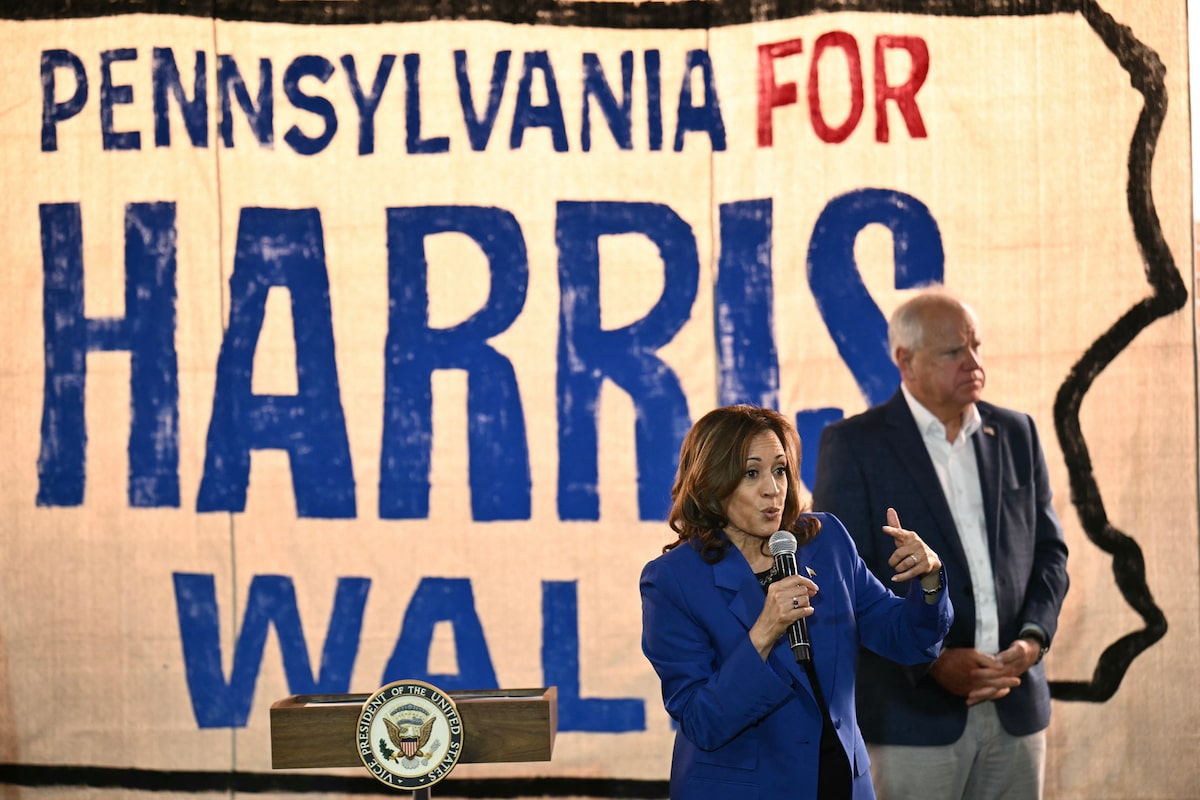

U.S. Vice President and Democratic presidential candidate Kamala Harris speaks as her running mate Minnesota Governor Tim Walz looks on during a stop on their campaign bus tour in Rochester, Pennsylvania, on August 18, 2024.ANGELA WEISS/AFP/Getty Images
It turns out that the route to the White House and the route Kamala Harris and Tim Walz are taking to the Democratic National Convention both run through this part of Southwestern Pennsylvania.
The Democrats’ nominees began their trip to Monday’s four-day conclave with a stop Sunday at Pittsburgh International Airport, where Ms. Harris and her running mate embarked on a bus tour through this region.
It was no surprise that the Democratic ticket began its journey to Chicago in Pennsylvania and that the Republican ticket also made appearances in the state.
“It’s the pathway to victory — the biggest prize of the states that are up for grabs and it is a most essential one for the Democrats,” Berwood Yost, director of the Center for Opinion Research at Franklin & Marshall College in Lancaster, Pa., said in an interview. “The demographic makeup of the state — a range of urban, rural and suburban communities, age and educational diversity, and a fair share of moderate voters — makes it a natural battleground.”
The bus tour that the Harris team began in Pittsburgh was designed as something of an introductory tour for a candidate whose name is known but whose character, views, inclinations and political style remain a blur after four years in the Senate and four as vice president. The larger purpose of her appearance here, as it will be in even more important appearances in Chicago and in a vital Thursday night acceptance speech, was to begin to define herself for the electorate in a positive light before Donald Trump, who has begun referring to her as “Comrade Kamala,” does it in a searing negative light.
Indeed, the race to define Ms. Harris is in some ways a proxy for the broader campaign, for Mr. Trump — himself perhaps the single best-known person on Earth — is at work trying to portray Ms. Harris as a loony leftist and “lunatic” with limited experience, intelligence, and competence. Speaking in the northeastern part of the state Saturday, Mr. Trump said Ms. Harris would “ruin” Pennsylvania.

Republican Presidential Candidate former U.S. President Donald Trump speaks during a campaign rally at Mohegan Sun Arena at Casey Plaza on August 17, 2024 in Wilkes Barre, Pennsylvania. Trump held a rally in the battleground state of Pennsylvania, a key swing state in the 2024 Presidential election against Democratic presidential candidate U.S. Vice President Kamala Harris.Michael M. Santiago/Getty Images
In advance of the convention, and to counter Trump campaign charges that the Vice President is avoiding setting out specific policy ideas, Ms. Harris on Friday delivered what her campaign described as a major economic speech in Raleigh, N.C., that emphasized controlling healthcare costs, a federal ban on what she called “price gouging on food,” subsidies for first-time home buyers, tax breaks for construction companies that build homes for first-time buyers, and an expansion of the child tax credit. The Financial Times/Michigan Ross Poll released late last week showed that 42 percent of voters trusted Ms. Harris on the economy as opposed to 41 percent for Mr. Trump; though that is basically a statistical tie, it represents a 7-percentage-point improvement for the Democrats from a month earlier, when Mr. Biden was the party’s presumed nominee.
Thursday’s poll gave Ms. Harris a 46 to 43 per cent advantage over Mr. Trump in Pennsylvania when third-party candidates are included. That edge is just within the margin of error of plus or minus 3.8 percentage points and is roughly in line with the two other polls conducted at about the same time.
All four members of the two parties’ tickets were in Pennsylvania over the weekend, with GOP vice-presidential nominee J.D. Vance in Lower Burrell Township, 39 kilometres from where the Democrats spoke, and with Donald Trump in Wilkes-Barre, a onetime coal centre in Luzerne County. The two Republicans are to return to Pennsylvania Monday, the day the Democratic convention opens.
The venues for the campaign visits underline the two parties’ matching strategies. Although the Democratic team scheduled a stop in Pennsylvania’s Beaver County, which Mr. Trump carried by 17 percentage points four years ago, both tickets have decided to inspire their political bases more than try to persuade the few remaining undecided voters. The latest Wall Street Journal poll found that only 15 per cent of the electorate was “up for grabs” in July, down from 28 percent a month earlier.
Can Kamala Harris sustain the momentum until November?
That explains why the Democratic team began its day Sunday in Allegheny County, which Joe Biden carried by 20 percentage points in 2020, while Mr. Vance appeared over the weekend in Westmoreland County, which Mr. Trump carried by 28 percentage points, and the former president appeared in Luzerne County, which he carried by 14 percentage points.
“They will be in the state physically and in the state through various advertising media,” said Professor Yost.
The campaigns are running both ground games and air games. Thus far the Harris campaign, with seven field offices in the western part of the state and with 36 Democratic offices across the state, has organized more thoroughly than the Trump team, which is concentrating its effort in the more diffuse rural areas in the central part of the state.
Since Mr. Biden withdrew from the race last month, the Harris and Trump teams have spent US$42-million, split almost evenly between the two campaigns, in Pennsylvania. That is more than double the US$17.8-million spent in Georgia. The spending here is most per electoral vote in any of the swing states — and almost twice the figure for Wisconsin, which has 10 electoral votes and ranks second in spending per electoral votes.
In recent days the two campaigns announced a total of US$190-million in advertising in the swing states before Labour Day, with Pennsylvania and its 19 electoral votes targeted for the largest share. The campaign plans a digital and cellular advertising offensive and said its purchase of television advertisements would be twice what Mr. Biden spent in Pennsylvania in 2020.
This article was originally published by a www.theglobeandmail.com . Read the Original article here. .