
This maxim might apply as well to the argument that human life begins at conception. Inarguably, this is true in the biological sense, but life is more complicated than mere biology. Sometimes, women — never men — are impregnated via rape or incest.
Where is our courage in objecting to such transgressions?
Never mind the verbiage that slipped the lips of President Biden during Thursday night’s debate when he attempted to answer a question about abortion access. In a discombobulated non-answer, he averred that “a lot of young women who are being raped by their — by their in-laws (!), by their spouse’s brothers and sisters … by … just … it’s just … it’s just ridiculous.”
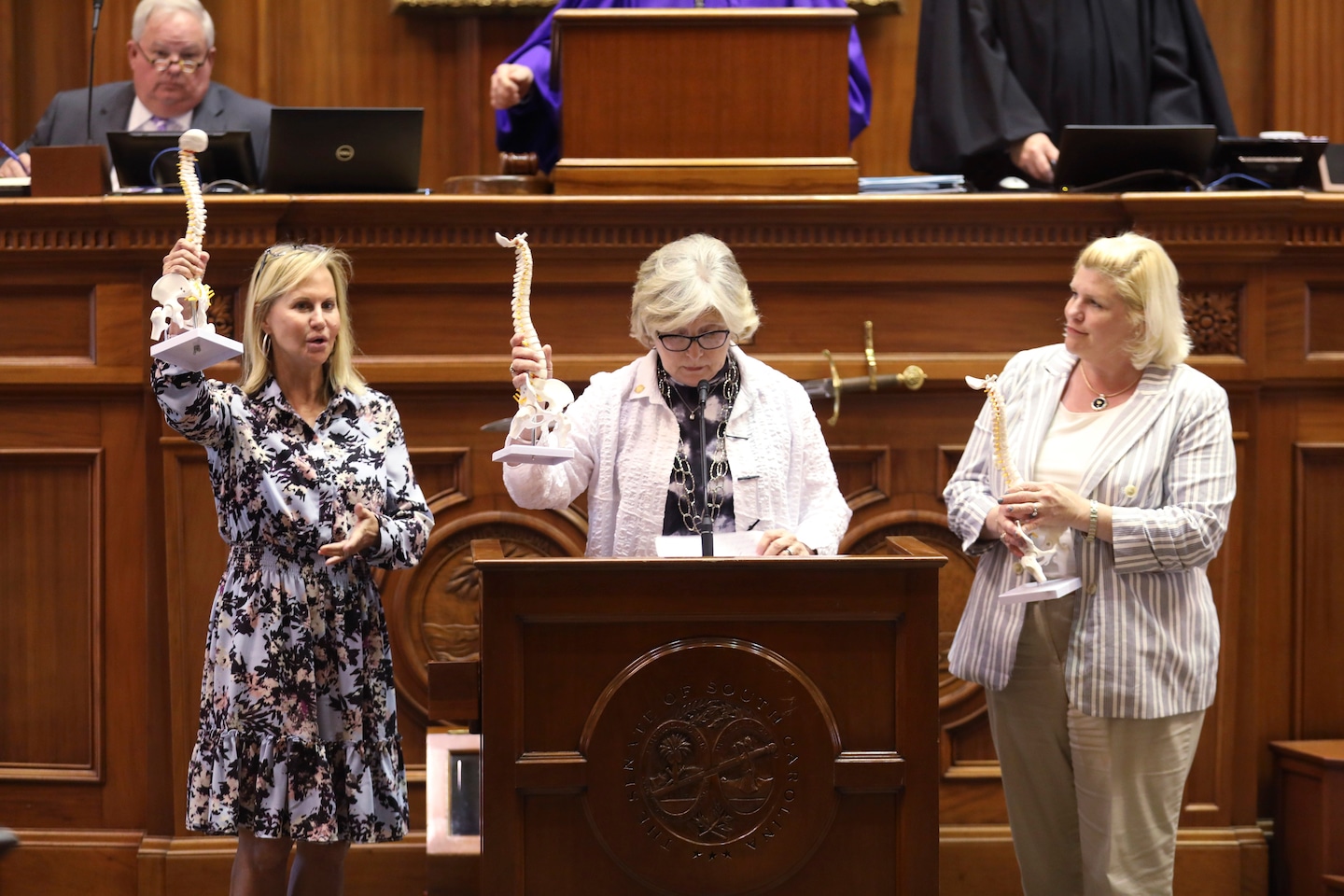
No one had to wonder about the courage of the five women known as the “Sister Senators” — three Republicans, one Democrat and one independent — who worked together to block a near-total state ban on abortion without exceptions for rape or incest. “Near-total” means no abortions after six weeks, by which time some women allegedly don’t even know they’re pregnant. (Note to women: If you have unprotected sex and miss a period, you’re probably pregnant.)
For their considerable troubles, the five women were honored with a JFK Profile in Courage award last year in Boston. But you know what they say about good deeds. I’m late in congratulating them and would like to correct my oversight herewith. The Republican women are state Sens. Sandy Senn of Charleston, Katrina Shealy of Lexington and Penry Gustafson of Camden. State Sen. Mia McLeod is an independent from Columbia, and Democratic state Sen. Margie Bright Matthews is from Walterboro. Thank you for your service.
Elsewhere in America, people may not see these women’s efforts as revolutionary. But in the conservative South, where churches outnumber Chick-fil-As (and that’s saying something), “uppity women” don’t last long in Republican circles. Five women in a room who aren’t arranging flowers or funerals, or serving booze to the boys, are held in suspicion, if not contempt, by some of their male counterparts.
Republican men can be a funny lot. Ten or so years ago in D.C., GOP staffers were sent for training on how to talk to and about women. I’m not joking. Mainly, this was so they could help their bosses avoid saying inappropriate things to women candidates during elections, but the gist was that Republican men generally don’t “get” women. As if we didn’t know.
For the record, Joe Biden received similar coaching in 2008 when, as a candidate for vice president, he had to debate Sarah Palin. If South Carolina had had its way, Palin would have become vice president. After writing in September that year that she should leave the ticket, I was almost afraid to go home for about two years. Chancing a cocktail party early in the Obama administration, I was swarmed by a dozen or more men who demanded to know what was so wrong with Palin. They were smiling, but then they always are.
I’ll admit I had to stiffen my spine to say what most everyone else was thinking. And no doubt the GOP sisters had to summon courage to risk their political careers to stand up for what they believe is best for women. Their critics said the three women claimed to be pro-life and flipped after Roe v. Wade was reversed. This isn’t precisely so. One can be pro-life and believe that rape and incest victims shouldn’t be forced to carry a pregnancy to term. One can also be pro-life and disagree with the Dobbs decision. I’ve always advanced the proposition that the best way to make abortion rare was through education, not legislative fiat.
To be sure, as some argue, it isn’t a baby’s fault if he or she was conceived through violence. I’ve spoken to people whose mothers were raped, and some (not all) do argue against aborting an innocent fetus. But I can’t imagine being forced to endure a nine-month pregnancy and give birth under such circumstances. This is personal in the extreme — and it is the least that pro-life advocates can concede.
The men who defeated the sisters aren’t bad people, I should say. It’s possible that they won for reasons other than abortion — but I doubt it. Carlisle Kennedy, who defeated Shealy, said the election was a matter of trust. On abortion, he supports the state’s “heartbeat” law, which bans abortion once the baby’s heartbeat can be detected around six weeks. This law, which Gov. Henry McMaster signed in 2023, allows exceptions up to 12 weeks of pregnancy for cases of rape, incest or fetal anomaly, or to protect the mother’s life.
This became the operative law in South Carolina after the total ban that the women had opposed narrowly lost in 2023. The women filibustered and, after several failed cloture votes, the senate voted to “continue” the legislation. In 2025, those obstinate GOP women will be gone, and the near-total ban can be reintroduced. All three of the new senators support the ban.
Whatever the outcome, it will be Republican men making decisions for and about women. Ladies, it’s time to get organized.
This article was originally published by a www.washingtonpost.com . Read the Original article here. .