
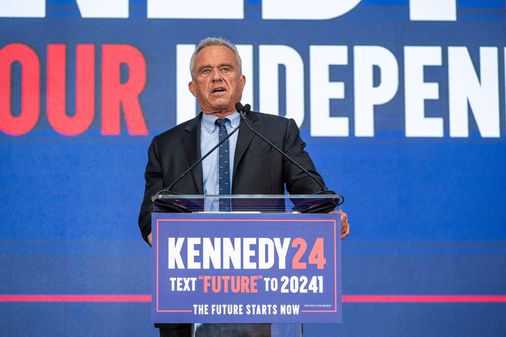
Robert F. Kennedy Jr., the independent presidential candidate who ran one of the most influential third-party bids in decades, is suspending his campaign, withdrawing from ballots in key battleground states, and backing former president Donald Trump, he said on Friday.
Kennedy said in a speech in Arizona that he would abandon his campaign, ending weeks of speculation about his political future as he faced ballot access challenges and lagging support in the polls.
Kennedy resists easy ideological categorization; he has a record of environmental activism that appeals to the left, along with a number of more right-leaning positions, such as an anti-interventionist approach to foreign policy and a pledge to “seal” the southern border. Both Democrats and Republicans had feared he would sap support from them in critical swing states, where he was pulling enough support to tip narrow margins of victory in either direction. National Democrats earlier this year stood up a legal and political effort to combat third-party candidates, particularly in battleground states.
Former president Donald Trump has been publicly critical of Kennedy, too, though in recent weeks he has made overtures to bring the third-party candidate onto his side. In the wake of a July meeting between Kennedy and Trump at the Republican National Convention in Milwaukee, as well as a leaked phone call in which Trump can be heard attempting to bring Kennedy into the fold, rumors have circulated that Kennedy would drop his campaign and get behind Trump, perhaps with an eye on a White House job. Kennedy spoke with Trump in July about the possibility of endorsing the GOP nominee and taking on a role on health and medical issues in a second Trump presidency, the Washington Post reported.
Kennedy built his campaign on his career as an environmental lawyer and anti-vaccine activist — as well as his place in the storied Kennedy political family, though his relatives largely rejected his presidential bid in favor of the Democratic ticket. Those with the closest claim on his family’s legacy — including several of his siblings, and a number of aides who worked for his father, US Attorney General Robert F. Kennedy — said RFK Jr. was not the proper heir to his family’s dynasty, and for many it was deeply painful to watch Kennedy trade on the family name. But for some supporters, RFK Jr.’s place in that storied history was part of his appeal.
Kennedy entered the Democratic primary for president in April 2023, billing himself as a “Kennedy Democrat” in his announcement speech at the Park Plaza Hotel in Boston. In October 2023, he pivoted to a third-party bid, calling on his followers to “declare your independence” from the country’s two dominant political parties.
Since then, Kennedy has been engaged in a state-by-state battle for ballot access, a challenging process with legal and logistical hurdles. Through a wide array of tactics — including signing on to run with little-known third parties — Kennedy has secured ballot access in a handful of states, including the key swing state of Michigan. In other states, Kennedy’s campaign claimed he had enough signatures to earn a position on the ballot, but election officials had yet to verify the names or confirm that he would appear on the ballot.
Emma Platoff can be reached at emma.platoff@globe.com. Follow her @emmaplatoff.
This article was originally published by a www.bostonglobe.com . Read the Original article here. .