
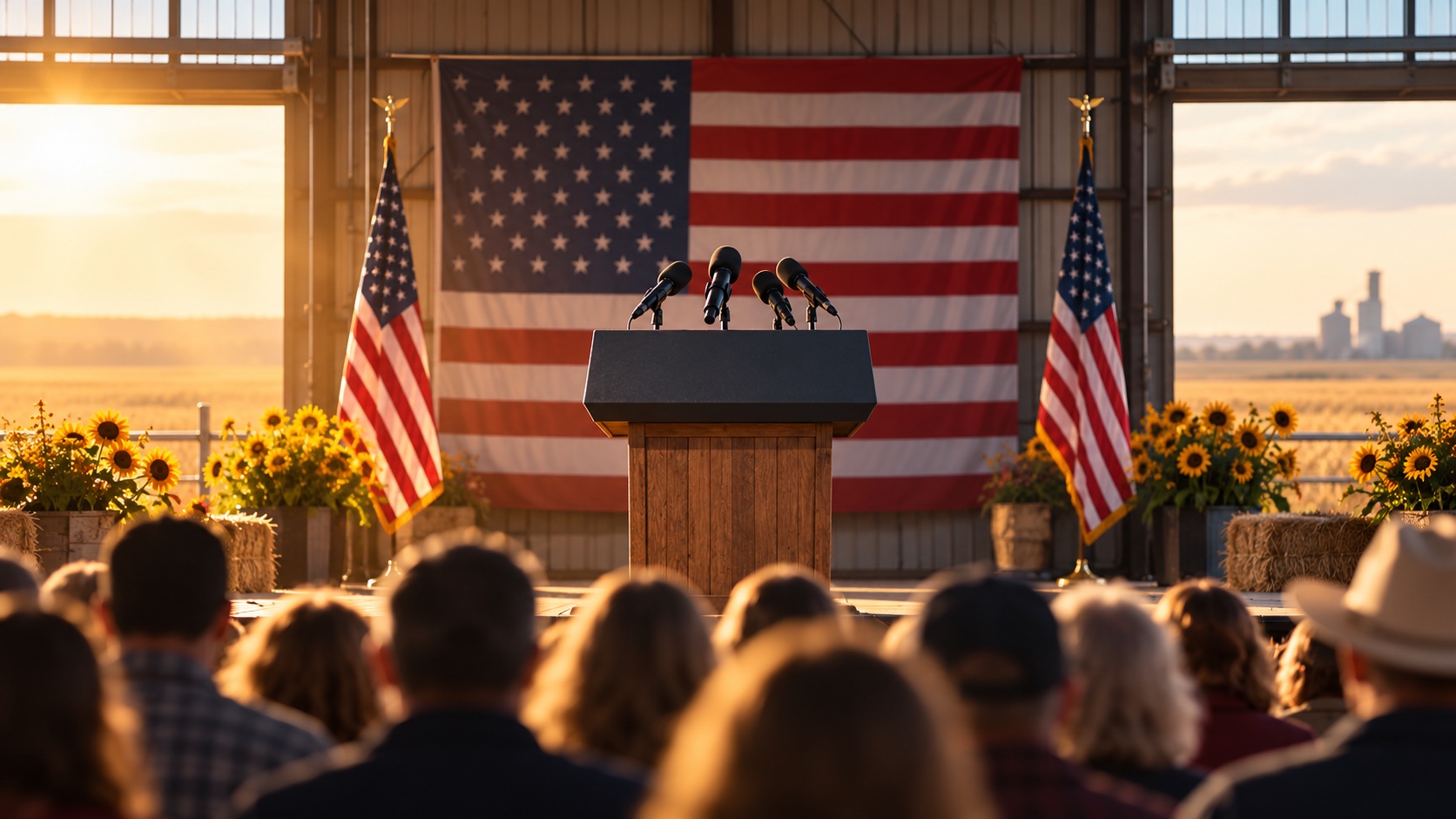
Vice President JD Vance is scheduled to return to Kansas on Monday for a Topeka rally supporting Republican Sen. Roger Marshall, another sign that the national party is giving unusual attention to a Senate race in a state that has not elected a Democrat to the chamber since the 1930s.
The official Republican event listing says doors at HME Inc. will open at 1:30 p.m. Central time and the rally will begin at 3:30 p.m. The appearance is planned for 3120 NW 25th Street in Topeka. It will be Vance’s second Kansas campaign visit in roughly six weeks, following President Donald Trump’s rally near Wichita last week.
Marshall is seeking a second term against Democratic nominee Adam Hamilton. The Kansas Secretary of State’s certified primary results show Marshall won the Republican nomination with 270,632 votes, or 79.9 percent, while Hamilton led a crowded Democratic field with 77,607 votes, or 34.63 percent. The general election is Nov. 3, and in-person advance voting must begin in every Kansas county on Tuesday, Oct. 27.
Why Kansas is drawing national attention
Kansas remains Republican territory. The party has held both U.S. Senate seats continuously for 94 years, and registered Republicans substantially outnumber Democrats. Those fundamentals still favor Marshall.
But the intensity of late spending and visits shows Republicans are not treating the race as automatic. The Associated Press reported that outside groups planned roughly $26 million in television and digital advertising, with total Republican spending alongside Marshall’s campaign reaching about $32 million. Democrats have also benefited from Hamilton’s fundraising, turning a race that would ordinarily receive limited national attention into a contest both parties must monitor.
Vance’s return is therefore about more than rally attendance. A vice-presidential visit can generate local news, recruit volunteers and focus voters on a race that might otherwise compete with gubernatorial and House campaigns for attention. It also lets Republicans nationalize the choice around Trump’s agenda while keeping Marshall tied to the administration’s most visible surrogates.
The event is being organized through a Trump joint fundraising committee rather than Marshall’s campaign, according to the official listing, which says it is not authorized by any candidate or candidate committee. That distinction matters for campaign-finance reporting even though the political purpose is plainly to mobilize Republican voters.
Marshall’s case to voters
Marshall entered the Senate in 2021 after serving in the U.S. House and working as a physician. His campaign has emphasized support for Trump, border enforcement, agriculture and conservative economic policies. In the closing stretch, the incumbent’s strongest argument is that Kansas should keep a Republican senator who can work with the administration and protect the state’s influence in Washington.
Hamilton is challenging that message with a campaign built around cost-of-living concerns, health care and dissatisfaction with the political establishment. His primary win came with less than 35 percent because the Democratic field was unusually large, but he emerged with enough fundraising and outside interest to force Republicans to spend in a state they typically count as safe.
The race also tests how much Kansas’s partisan history can predict a midterm election shaped by national conditions. Marshall does not need to win over a majority of Democrats. He needs to consolidate Republicans, limit defections among independents and ensure that GOP voters participate in a crowded ballot.
What to watch at the rally
Because the rally has not yet occurred, any account of Vance’s remarks would be premature. The official event page identifies him as the special guest but does not publish a speaking program or list other participants.
The clearest signals will be which issues Vance chooses to emphasize and how directly he frames the race as a referendum on control of the Senate. Republicans can use the visit to connect Marshall with the administration’s economic and immigration record. They may also try to counter the Democratic spending surge by reminding voters that a close state contest can affect the national balance of power.
For Marshall, the most immediate objective is turnout. Kansas begins mandatory statewide in-person advance voting the day after the rally, creating a short path between the event and ballots being cast. The campaign will want the vice president’s visit to produce more than a one-day media burst.
Voters should rely on the Kansas Secretary of State’s election site for registration, advance-voting and polling information. The office lists Nov. 3 as Election Day and Dec. 1 as the deadline for the State Board of Canvassers to certify results.
Kansas still leans Republican, and Marshall retains the advantages of incumbency and party registration. But a second Vance visit, a recent Trump rally and tens of millions of dollars in advertising make the closing argument unmistakable: national Republicans believe the seat is important enough to defend in person.