
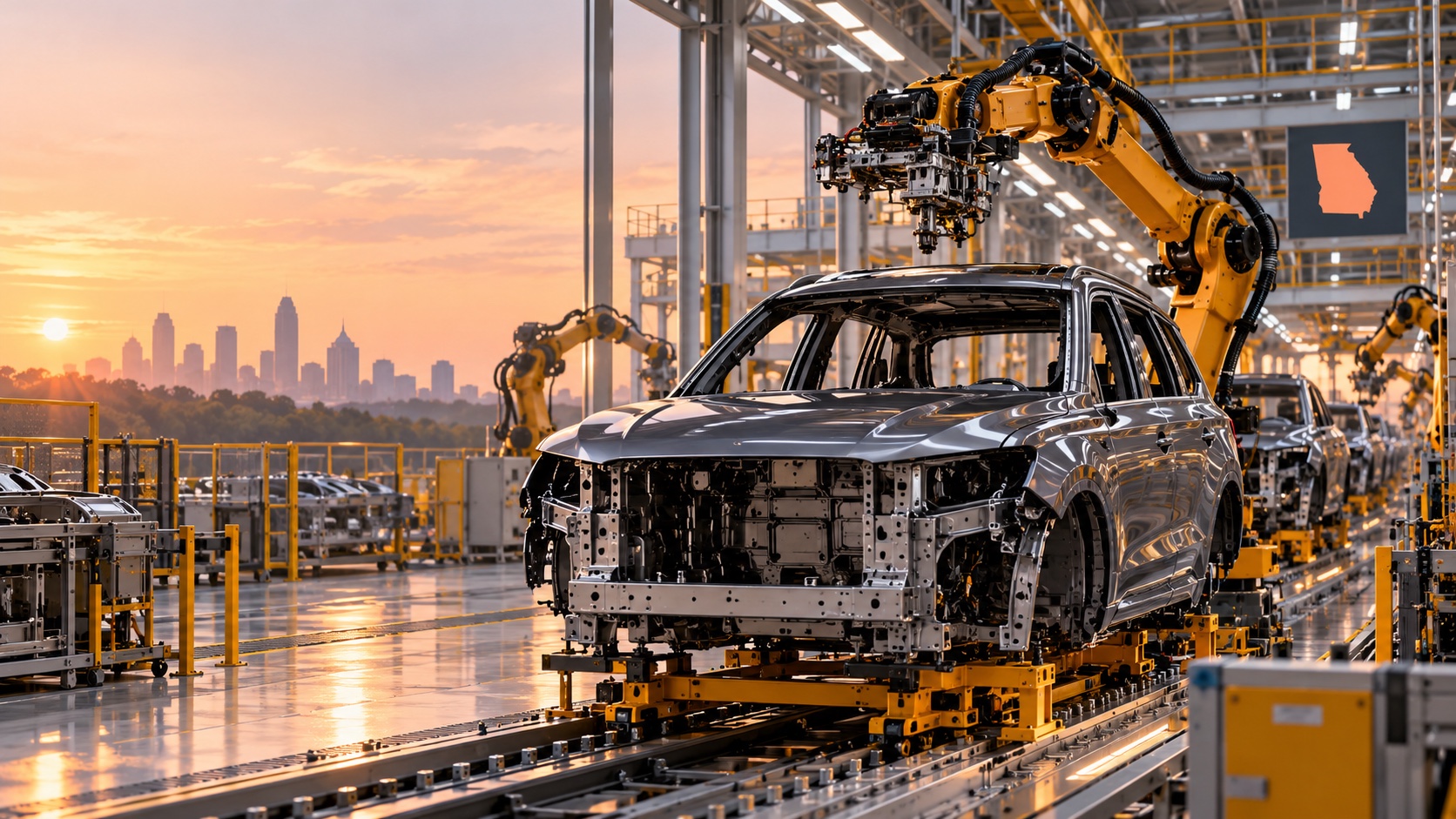
Audi plans to build its first U.S. manufacturing plant in Georgia, a roughly $4 billion project that the company says would create about 4,500 jobs and add capacity for as many as 200,000 vehicles a year.
President Donald Trump announced the project Saturday during a campaign rally in Perry, Georgia, placing the investment inside his broader argument that tariffs and domestic-manufacturing policies are bringing production to the United States. Audi’s own release describes the project as a long-term growth decision designed to serve North American customers, reduce trade and currency risks and establish a third major production pillar alongside Europe and China.
Those accounts overlap on the basic facts but are not identical. Trump cited a $4.2 billion investment, while Audi and Georgia economic-development officials put the planned investment at about $4 billion. The company has not said that tariffs were the sole cause of its decision.
What Audi has committed to do
Audi says the factory is planned for the Middle Georgia Megasite, a large industrial property near Interstate 16 in Twiggs County. Construction is scheduled to begin in 2027, with vehicle production expected in the early 2030s.
The company intends to build premium sport-utility vehicles tailored for North American customers. It has not announced the specific models, powertrains or supplier roster. The stated annual capacity of up to 200,000 vehicles is a ceiling rather than a first-year production guarantee.
That timeline makes the announcement an important commitment, but not an immediate hiring surge. Site work, permitting, incentive agreements, supplier decisions and construction must come before production jobs arrive. Prospective workers should rely on Audi and official Georgia hiring channels rather than third-party job solicitations that may appear after a high-profile announcement.
Audi Chief Executive Gernot Döllner said the company sees substantial growth potential in the U.S. premium market. The Georgia plant would give Audi a domestic manufacturing base comparable to those already used by other German automakers in the Southeast.
Georgia’s manufacturing pitch
Gov. Brian Kemp welcomed the project as another major addition to Georgia’s automotive sector. The state has spent years assembling a network of battery, electric-vehicle, parts and logistics projects around its highways, rail connections and the Port of Savannah.
The Middle Georgia site offers access to Interstate 16 between metro Atlanta and the coast. For Audi, that location can support inbound parts and outbound vehicles while placing the company near a growing Southern auto-manufacturing workforce.
The public cost of the deal is not yet fully clear. Georgia’s announcement confirms the planned investment and employment figures, but a complete package of tax credits, grants, infrastructure commitments or local incentives was not detailed in the company materials reviewed for this report. Those terms will matter when lawmakers and taxpayers evaluate the project alongside its promised jobs.
The political setting
Trump used the announcement at a Republican campaign rally as evidence for his economic agenda. The Perry event was aimed at energizing Georgia voters as Republicans try to defeat Democratic Sen. Jon Ossoff and retain control in state races.
The president credited tariffs for the decision. That is a political claim about cause, not a finding established by Audi’s release. The company emphasized local production, growth, customer access and reduced exposure to trade and exchange-rate volatility. Tariffs can make imported vehicles more expensive, but manufacturers also weigh labor, logistics, incentives, supplier access and long-term demand.
The distinction is important because large industrial projects are almost never the result of a single policy. Georgia’s existing manufacturing strategy predates this announcement, and Audi’s timetable stretches across multiple election cycles.
Republicans will nevertheless point to the project as a tangible investment announced during Trump’s second term. Georgia leaders can also present it as confirmation that the state’s recruitment strategy remains competitive for global manufacturers.
What comes next
The near-term milestones will be more revealing than the rally announcement: acquisition and preparation of the site, disclosure of incentive terms, permits, construction contracts and the first supplier commitments. Audi will also need to identify which vehicles it expects to assemble and how the factory fits with the Volkswagen Group’s wider North American network.
If the project proceeds on schedule, it would give Audi a substantial U.S. production footprint and Middle Georgia one of the state’s largest recent manufacturing investments. The announcement is significant, but the jobs and vehicles remain years away. Progress should be measured against the company’s 2027 construction target and early-2030s production plan.